Dust tightness is particularly important in industries such as food ingredients, dairy, infant nutrition, plant-based ingredients, specialty chemicals, and feed, where product quality, hygiene, operator safety, and regulatory compliance are critical.
A
dust-tight installation prevents product from escaping through flanges, valves, inspection hatches, and other critical connection points. The result is improved product quality, greater process reliability, and a cleaner production environment.
Why dust tightness matters
The benefits of a dust-tight installation go far beyond housekeeping.
Dust-tight systems help to:
- Reduce product loss
- Minimize the risk of cross-contamination
- Limit operator exposure to airborne dust
- Improve overall process reliability
- Help prevent the formation of combustible dust clouds
Even relatively small dust leaks can have significant consequences. They may affect ATEX zoning, increase mitigation requirements, and complicate compliance with NFPA dust hazard management and housekeeping requirements.
Achieving true dust tightness
Dust tightness in powder handling is achieved through a combination of equipment design, containment strategies, automation, proper installation, and maintenance.
Achieving true dust tightness requires more than selecting the right seals. It depends on a combination of:
- Hygienic design principles
- High-quality components
- Precision manufacturing
- Proper installation
- Regular maintenance
When these elements come together, manufacturers benefit from safer, more efficient, and more reliable processes with lower operating costs and improved compliance.
Dust leaks are often an air leak problem
Visible dust emissions are often the symptom, not the root cause. In many powder handling systems, dust is not escaping because there is too much dust. It is escaping because air is moving where it shouldn't.
Small leaks around connections, valves, inspection hatches, rotary valves, or bag interfaces can disrupt the intended airflow and pressure balance within a system. As air escapes or enters where it shouldn't, product particles can be carried along, resulting in dust emissions, product loss, contamination risks, and reduced process stability.
That is why effective dust control starts with proper containment and airtight system design, rather than relying solely on downstream dust collection.
Hidden dust leaks could be costing more than you think
Many manufacturers accept a certain level of dust emissions as unavoidable. Product loss is often the most visible consequence, but the hidden costs can be far greater. Additional cleaning, increased maintenance, contamination risks, production interruptions, and increased ATEX or NFPA dust hazard mitigation requirements can all originate from relatively small and often overlooked leak points.
The reality is that dust emissions can often be dramatically reduced through the right combination of smart design, reliable containment, and automation.
The first step is identifying and eliminating leakage at the source before relying on extraction or housekeeping measures to manage the symptoms. Dust-tight connection systems, such as J-Tec's pipe clamps and Big Bag connection clamps, create secure and reliable seals that help prevent dust from escaping while maintaining efficient operation.
The following example demonstrates how a properly designed Big Bag connection can significantly reduce dust emissions during material transfer.
[embed]https://youtu.be/ZKXW0CeM2Ao[/embed]
Taking dust control one step further
While dust-tight connections are an important part of the solution, automation can further improve containment by reducing manual handling.
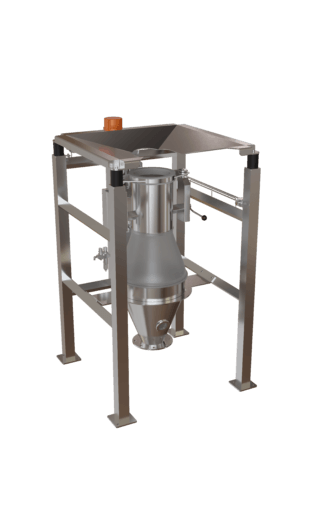
J-Tec's automatic bag emptying system, for example, lifts bags directly from the pallet, opens them, and discharges the contents into the process within a fully enclosed environment.
The result:
- Improved containment
- Reduced operator exposure
- Enhanced NFPA / ATEX and combustible dust safety
- More consistent process performance
A system approach to dust tightness
Dust control is rarely determined by a single piece of equipment.
Whether you're upgrading an existing installation or designing a new production line,
achieving long-term dust tightness requires a system-wide approach that considers equipment design, transfer points, operator interaction, and process automation. By addressing dust emissions throughout the process, manufacturers can improve safety, hygiene, efficiency, and overall operational performance.
J-Tec Material Handling helps manufacturers design and implement dust-tight powder handling solutions that improve containment, reliability, and process performance.
Dust leaks, product loss, housekeeping challenges, or NFPA concerns impacting your operation? Stop by and meet the J-Tec team at Pack Expo 2026 to explore practical containment improvements designed for safer, cleaner, and more efficient powder handling. Find us at booth LU-7454.
Reach out to our Pack Expo team if you need a ticket or to schedule a meeting:
Cannon Madison
cannon.madison@j-tec.com
+1 8327844731